Independent Projects
Reining In a Runaway Wix Site, One Click at a Time
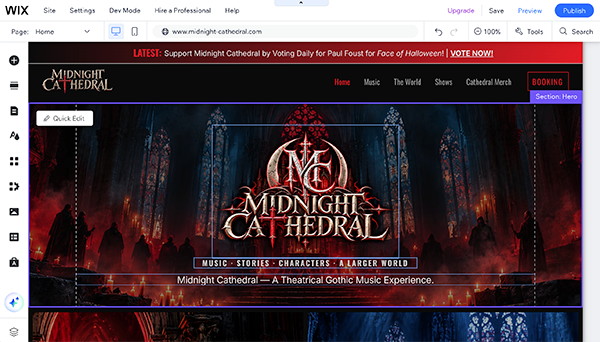
Repositioning and rebuilding the inherited Midnight Cathedral website for bookings — using Kiro as a guide through a platform it couldn’t drive
I have a long history of building web sites, and the many bands I’ve been in over the years have often been the subjects of the sites I’ve built. At several points over the years, it has fallen to me to design the logo and/or build the web site for the band. From The Big Chicken Beatles Band to The 80ators to New Sensation to Headgames, I’ve been the logo/website guy by default, and that has suited me just fine. From my earliest days following bands, I’ve always known the importance of a good logo and marketing, and it has always been super fun and natural for me to have those things in mind whenever I’m involved in a project, especially bands.
Not until my involvement with Midnight Cathedral, however, have I had such a rich collection of content to work with. This is more than a band. It is a theatrical experience being built from the ground up with heavy emphasis on world-building, lore, and a preconceived collection of audio recordings and novel publications. When the time came to put a band together to perform the material, I was contacted for the keyboardist role. My storied and layered history of rock performance, even theatrical performances, made me a good fit for the band and the show.
There already was a web site, but it hadn’t been built with an orientation towards booking shows. It was more about the world-building. When I was tapped to see what I could do to reposition the site to make the product seem more viable and geared toward venues and bookers, I took it as a welcomed challenge.
In 2026, my “AI Renaissance” involves using Kiro, an AI-assisted development environment, to do lots of things from my “day job” work creating reports, communications and dashboards, to building video games, to personal applications, and, of course, designing and building new websites. My personal site and the Headgames site were built using Kiro as the coding environment, and it’s a great way to work.
For Midnight Cathedral, however, the web site already existed, and (shudder), it was built in Wix. When this kind of site-building environments came online many years ago, that was the beginning of my exit from the website contract work I had done for many years before that. In the early years, things had to be coded by hand, and I was proficient enough to find the odd contract job doing just that. As more do-it-yourself development platforms like Wordpress and others became the norm, I was less inclined to embrace them. When Kiro came around, and I discovered I could once again build completely custom web sites to my own specs and under my own creative control, I dove right in. The challenge for Midnight Cathedral was going to be working within the Wix environment, and it took me some time to warm to that concept.
But Kiro remained an important part of the process, however. After taking an inventory of what was out there on the existing Wix site, I then worked in Kiro to devise a new structure and a new plan for reconfiguring the site. The beauty of it was that Kiro could not only help me organize the site conceptually, it could also walk me through the Wix platform so that I could build almost exactly what the new plan and designs called for. Instead of struggling to learn the platform on my own and getting frustrated at every turn when I things don’t work the way I think they should, I let Kiro guide me through the menus and panels to manually create what Kiro might’ve done on its own in the background.
Here is the part that made the arrangement work. Kiro can’t touch the Wix editor. It can’t click a button or drag a handle, and it can’t see my screen unless I send a screenshot, so every click on this project was mine. What it could do was everything around the clicking. It could read the live site from the outside, keep the plan straight, work out the exact path through the menus for each step, and handle the heavy lifting on my own computer where the browser doesn’t reach. Think of it as a co-pilot who has the whole map in its head and no hands on the wheel. This was the third live site I’ve worked on with Kiro, and the first two were hand-built, with Kiro writing the code. This one asked a completely different job of it, and of me.
The inventory turned up more than I expected. The site’s owner, who would be the first to tell you he isn’t a web person, had too many media files in Wix’s library storage. His Wix account was sitting at about 1.78 of its 2 GB of storage (89% full, if you like your numbers blunt), and the art folder he’d handed over held 313 files weighing 748 MB. A hundred and two of those were trashed files that had been deleted upstream and then synced back down as junk. Most of the rest were 2 to 7 MB PNGs with names like file_00000000183c720ca7f0e5a3ef7fb95b.png, which tells you nothing, and plenty were print-resolution iamges that don’t belong on a web page at full size. A site needs maybe 15 to 25 good images, not 211.
We didn’t try to shrink all of it. We quarantined the junk, catalogued every file, and built contact sheets (plain HTML pages, nothing to install) so I could actually look at 185 hash-named images and decide which subgroup mattered. I also caught that my first round of nav work was desktop-only, since Classic Wix keeps a separate mobile layout that doesn’t inherit any of it, so mobile became a step in every phase instead of a cleanup job for the end. From there we started on the pages themselves, one at a time, with Kiro walking me through every panel.
It was good exercise - stepping through menus in a new development platform, sending screenshots to Kiro when I’d get stuck, getting feedback on what to do, what options to select, and what attributes to give certain elements, and going in and doing those things by hand. It actually turned out to be another great use of AI-assisted development - having a guide walk you through a process you have to do manually, but in a platform at which the guide is an expert, so getting stuck is not something that happens. There may be limitations to the platform, decisions which must be made, weighing the consequences of this or that, and those are all things I’ve had to think through and decide myself, just like the old days of building websites by hand completely on my own. I obsessed over this site for a month, spending many hours positioning text and graphics, and tweaking minute aspects endlessly. The great thing has been the avoidance of the frustration I might’ve felt at hundreds of points in the process if I didn’t have a tool like Kiro to help keep the plan and the process in focus.
The Platform Fights Back
Wix fought back in small, sneaky ways, and this is where having a guide earned its keep. There’s a blue “Save to Theme” link that sounds like it saves your changes. What it actually does is promote that one element’s style to the default for every heading on the site. I would have clicked it without a second thought. Kiro stopped me, and I said as much at the time: if I didn’t know better, that would be an obvious choice, and Wix continues to be the opposite of what I would want as a web designer. The “Heading” presets are visual sizes and not real HTML heading levels (H2 is bigger than H1 out of the box), and there’s no uppercase toggle at all, so you type your headlines in caps. The free plan caps a form at 10 fields, which I found out on the eleventh. I’d wanted 14 for the booking form, so we cut the four optional ones. Fine. I have no wish to cost anyone more money upgrading a subscription for a business that’s just getting off the ground.
It wasn’t one-way traffic, either. Kiro misread things, and so did I. Early on it warned me that dragging a text box wider would hard-code a pixel width and wreck the mobile layout, and I asked whether that was even true on a platform with a separate mobile view. It wasn’t, and Kiro said so and changed course. Another time I spent a while fiddling with a 50/50 column split to line up a row of book cards, and the real problem was the strip’s outer margin, a couple of levels up from where either of us had been looking. (A second screenshot settled it. The first one had sent us both the wrong way.) That’s the honest texture of the whole project. Kiro wasn’t an oracle. It was a collaborator that would revise when I pushed, and I’d revise when it showed me why.
A lot of the work had nothing to do with clicking. the site owner approves anything that speaks for the band, so every piece of new copy went to him first, and the words he’d already approved stayed his. The audit also turned up things nobody had asked for. The privacy policy was Wix’s fill-in-the-blank stub. The accessibility statement still had its [bracketed placeholders] showing, and it claimed the site had alt text and clean heading structures that it didn’t. We rewrote the privacy policy to match what the site really does, which is two forms and Wix’s own analytics with no outside trackers.
Two Instruments
Since Kiro couldn’t see my screen, we ended up with two instruments. It would fetch the live pages from the outside and count things I’d never catch by eye: exact page titles, redirects, how many times a name showed up on a page. I’d screenshot and check on my phone, because it was blind to text baked into images, to the mobile layout, and to alt text. Neither one alone was enough. When it was decided we would stop calling Midnight Cathedral a “band” and say “group,” a sweep showed that most of the instances were things like “tribute bands” in the members’ bios, and only about four places where the word was actually labeling us. One of those, “more than a band,” stayed, because changing it would erase the point. This is the kind of thing it takes a human to direct.
I also caught a lapse of Kiro’s own. The notebook it was keeping about this project had gone five days without an entry while it was busy building, and it was me who asked whether it was still taking notes. It wasn’t. It reconstructed the gap from the plan documents and said so. Over the course of several sessions and multiple “pickup prompts”, sometimes things just get lost in the shuffle and frenzy of activity.
The last piece was the Meet The Group page, which waited weeks on the band member bios to come in. When the page went live on November 3, checking it turned up a bug that had been sitting there for months. The logo in the header linked to the old /home address on every page, so the most-clicked thing on the site took a pointless detour through a redirect. One edit fixed it everywhere. By the end of that day every page in scope was built, published, and checked.
Looking Again After I Thought I Was Done
I figured that was it, and then we went looking for leftovers. A crawl of every page in the sitemap (50 URLs in all) showed the live site was using only about 147 MB of images, which didn’t square with a library pushing 2 GB. The storage culprit was video files. Once I found some redundant, gigantic video files in the media library and deleted them, usage dropped from about 1.78 GB to 596.72 MB of the 2 GB.
On the day I called the project closed, a fresh session of Kiro started by telling me that several things were still open that I’d settled weeks earlier. It had read the pickup note and not its own memory of the project. I had to ask whether it could see the history. It could. It just hadn’t looked. That’s the same lapse as the skipped notebook entries, and the fix is the same one: somebody has to ask. AI-assistance is great, but still requires human input and guidance.
Like all my websites, midnight-cathedral.com is an ever-evolving work-in-progress. We’ve got a long way to go before the site truly communicates all that it needs to in order to be successful as a funnel for business. However, the redesign and rebuild has been a success. The old site has been completely reworked. We’re now into the phase of updating and improving what’s there and bringing real-world news and content into the site so that it becomes even more of a living, breathing useful entity, which is what, to me, a good web site is. Time to rock!
Midnight Cathedral is an original theatrical gothic metal project combining music, storytelling, and stage presentation. Explore the rebuilt site at the official Midnight Cathedral website.
Impact at a Glance
What This Demonstrates
- Working Within a Platform I Didn’t Control
- Rebuilding on Classic Wix, where the tool couldn’t drive the editor, so the value came from planning, guidance through the menus, and outside-in verification.
- Human-in-the-Loop AI Development
- A clear division of labor: I made every click and every creative call; Kiro planned, found the exact steps, and did the local heavy lifting the browser couldn’t.
- Judgment and Triage
- Reining in a site that got away from its owner — deciding what to change, what to leave, and what to route back to the owner for approval.
- Verification as a Discipline
- Two complementary instruments covering each other’s blind spots: Kiro reads and counts what the eye skips; I check the image-baked text, the mobile layout, and the live result.
- Systems Thinking
- Treating storage, assets, structured data, and a messy inherited sitemap as one system, and finding the real problem instead of the one the plan assumed.
- Finishing the Job
- Looking again after “done” — the crawl that surfaced a fake store, a phantom booking system, and the storage that was actually filling the box.