Essay
Performing On My Own Terms
My relationship to music performance has been an interesting, conflicted journey. Performance is something I had to find my own way into and carve it into a version I could live with, rather than doing it merely to please others. Now, in my 50s, I feel like I'm finally doing things on my own terms, and being this age also means I'm better able to accept whatever level of “success” music brings me. I do it for me. I do it for the art and creativity, and I do it because making music comes very naturally, even if performing doesn't always. However, it's still something I wrestle with inside, but I think it's a pretty common introvert/extrovert dichotomy that many people also experience, but this is my story.
I gravitated toward the piano because of my older sister, who was ten years older than me, and played the piano in the house. She took lessons for maybe three years, from age 9 to about 12. She excelled at playing, and the sound of her playing the pop songs of the day on the piano are part of the deep background music of my mental landscape. I started taking lessons myself at five years old. Neither of us particularly wanted to practice or go to lessons, but I think I took to it more than she did. Her desire was to try things, do things her friends were doing, and then move on. For me, it was a deeper connection I had with the music that kept me in it for the better part of a decade, although I eventually stopped.
I also performed at church and school. A lot. Some of my earliest memories are of playing in the school talent shows every year and playing Christmas songs at church programs at Fair Oaks United Methodist Church, where I grew up. While the talent shows were my first foray into “show business”, and the church performances were intrinsically part of my early Christianity, they were both far more enriching and interesting to me than the recitals and competitions that were part of the piano lesson era.
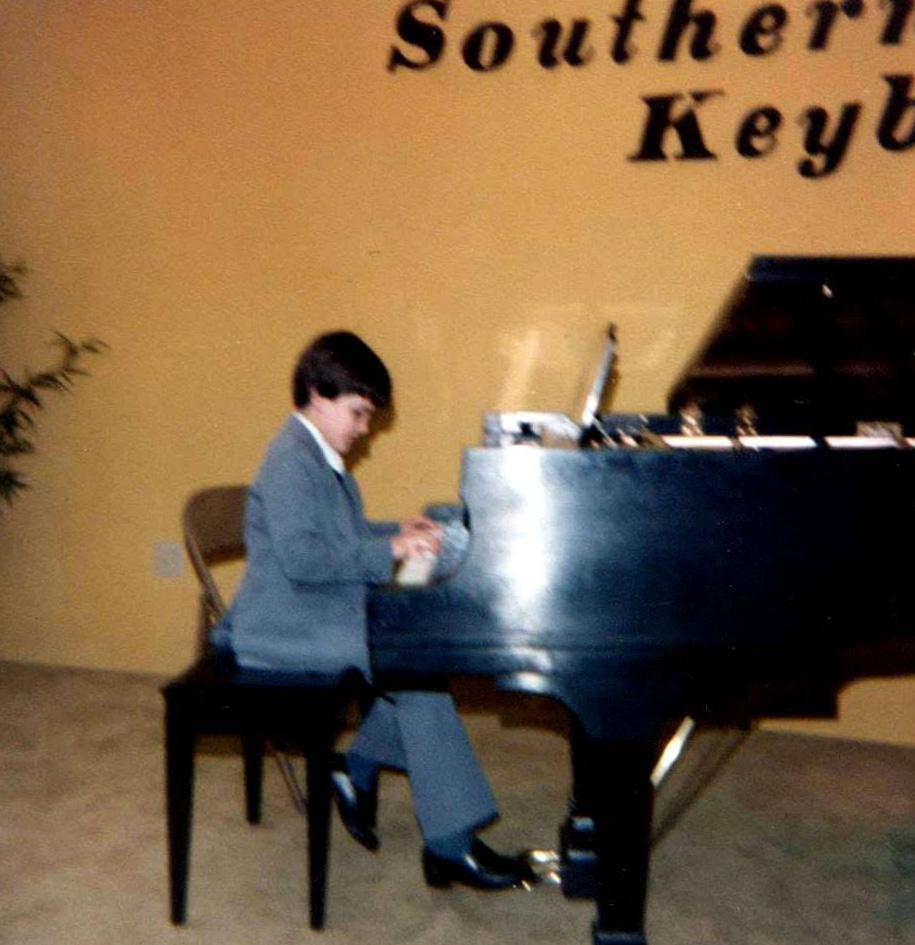
From the first experiences with lessons, there were always recitals, competitions, and pressure to perform as part of the learning process. I loved the music, and being able to play it, but I liked doing it my way, which usually meant by ear, rather than by the sheet music.
I had several teachers over the years, and they all did things differently. The early teachers, “Miss Pam” and Nancy East, were like my elementary school teachers. Then came a very interesting and cool teacher, Cindy Reid, who was a pianist at a big church. I liked her a lot, but she moved away, which saddened me. Even with her, though, I resisted working hard on sight reading and really trying to master the music as written on the page. Some quirk of my personality made that whole effort seem abhorrent at the time. Looking back, I should've applied myself more to the challenge of it, but I just wasn't thinking like that.
The next teacher, Jackie Hudson, was the one that really drove me away from lessons in general, because she was super-focused on competitions and sight-reading, my two least-favorite things about the whole scene. That was the first time, in my early teens, in which I expressed my desire to stop. After a year or so with her, I did. I didn't hate playing piano. I just didn't care for the prescribed and overly-governed definition of what a pianist could be.
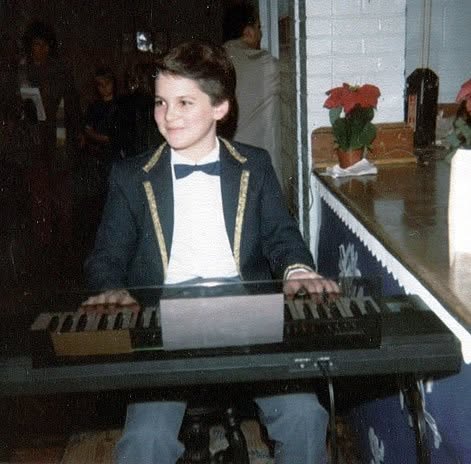
In 1984, when I was in 8th grade, I played what I consider to be my first gig: providing interstitial music during the school talent show. I had performed as an act in nearly every annual talent show all the way through school, but that year, I was set up on the side of the stage, and had a series of songs I would play in between acts, as stage changes were happening. I took it very seriously. My parents had bought me a Lowry Micro Genie keyboard, which had many voices, rhythms and accompaniment options. I spent hours and hours with that thing, and I created a songbook for myself showing the settings for each song I wanted to play. My numbers included “Popcorn”, “Eye Of The Tiger”, and “Rocky Top”. Something for everyone, I figured! As I think back now on that particular performance project, I realize I was never particularly interested in being a pianist in the traditional sense. I was more interested in creating musical experiences, and that has clearly always been my focus.
But then in early high school, I met someone in class whose mother, Jeanne Bowers, taught piano. By that time, I was starting to be interested in playing for congregational singing at church. This time, I had a requirement if I was going to sit under another teacher: show me how to open a hymnal, read the SATB music, and fill in the rhythm and improvisations needed to carry the music for people to sing over. I recognized that what the church pianists were doing was more than what was written on the page, and that was the first time it clicked with me that they had a skill beyond merely reading the notes: They were creating music in their own style in the moment, which is exactly what I wanted to do. It was a true revelation that opened my eyes to a wider personal musical world. That teacher was very laid back but had a definite set of skills and techniques (basslines, arpeggios, keeping the melody on top, adding filler notes to maintain the rhythm) she taught me that have carried me through my entire musical life ever since. We're still friends to this day, and while I value the formative, rudimentary and foundational instruction I got from my other teachers, the improvisational possibilities that opened for me because of my final piano teacher's efforts are something for which I will forever be grateful.
Once I had those techniques down, and I started playing for congregational singing at church, I stopped taking lessons. I was nervous before every service, and made lots of mistakes, but I went from playing for the less formal Sunday night services to the more formal Sunday morning services. I preferred playing the organ to playing the piano, as I felt like the piano required more skill and mistakes were more obvious on the piano than on the organ. I had many talented and inspiring players and music leaders at church to emulate, and I took valuable lessons from them all, from how to recover from mistakes, to not taking things to seriously, yet striving for excellence, to finding “shortcuts” that kept things going musically but didn't require as much effort. Lots of things musicians and especially keyboardists all know, but which were new to me.
I say I was nervous before every service. While I had learned how to improvise out of a hymnal, I was still drawing from my extensive familiarity with a subset of hymns I had sung growing up. Learning new ones was tough, because it involved sight-reading, which I wasn't good at. While I have a set of “standard” hymns in my head, and have never had any trouble playing those, there were also a large number of hymns in the books that I didn't know and couldn't sit down and play through on the spot. In the less formal services, the congregants had a habit of yelling out song requests, and that was always nerve-wracking, because the expectation was that a normal pianist could open the book, and simply read the song, improvising the accompaniment, knowing exactly how the intro should start that would lead the singers into the first verse, and being familiar enough with every possible key a song could be played in. The pressure of that I did not like, and always much preferred knowing the hymns ahead of time so I could have time to practice them, make sure I knew the intros, etc. To this day, I'm a stickler for knowing a set list ahead of time, and being as prepared as humanly possible for what's coming next in a given performance. I have some talent for playing, but I've never been as quick on my feet as I needed to be to really thrive in high-pressure music situations. Eventually, I eliminated those situations from my musical activities altogether, since on-the-spot improv is just not my forte. For many years I was ashamed of that limitation in my abilities, but now it's just part of my own personal requirements for performing, and I only put myself in situations where I don't have to feel that old nervous feeling anymore. I spent years viewing this limitation as something I needed to overcome. Now I understand intense personal preparation beforehand is simply one of the conditions under which I work best.
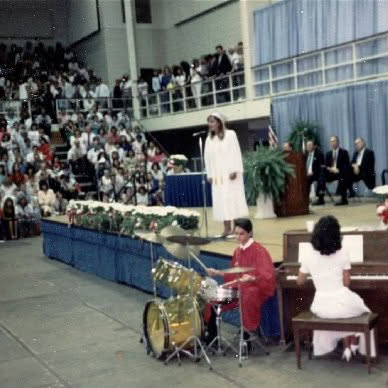
Since I had gravitated towards percussion in the school band, I also became a drummer, and once in high school, I sat down at a real drum kit for the first time, immediately landing a position as the drummer for the school chorus, with whom I performed many times at school events (some of which included my future wife, Bridget as one of the singers). The most visible performance on drums for me at the time was playing at my own high school graduation. Drumming was easy, and didn't require nearly as much preparation as piano.
I did play keyboards a couple of the talent shows in high school. One was a solo piano performance of one of my tired old piano recital pieces, but the one I'm most proud of is the Rush medley I played on two keyboards with a fellow drumline member on a drum kit. We played a medley of Tom Sawyer, Time Stand Still, and The Spirit Of Radio, and in my memory, we killed it! Many of my schoolmates over the years have reminded me of that moment and how cool it was. I only wish there was video of that performance. At the same time, however, I also realize that our memories of it have gotten enhanced over time, and if I were to see and hear the stark reality of a recording of that performance, I'm sure I'd cringe over it! At the time, however, it was a creative endeavor, and something we came up with ourselves, and that in itself is something I'm proud of, and a personal way of doing things I've carried with me ever since.
I was the church organist in college. Not only that, but I also played around town for weddings, funerals, Christmas programs, and other events. I've often joked (actually, revealed) that when I've been called upon to provide background music for funeral visitations and other events, I've often snuck Beatles or KISS songs into what I was playing. I'm sure lots of keyboardists have done that, but I always enjoyed doing that! One of my favorite organ gigs was playing for a service at the chapel at Dobbins Air Force Base in Marietta, GA. I don't remember how I got the opportunity. I think I was substituting for someone else, and I think they had a rotation of organists who played. It was my first time playing an “away” service on a Sunday morning, rather than playing at my own church. The chapel isn't there anymore, but I have fond memories of it, and it was a cool feeling showing up as a “guest organist”, doing my thing to assist with their service, and then driving away.
These church performances weren't performances in the way a rock show is a performance. As a Christian musician, I understand that the purpose is not to “perform”, but to worship, and humbly provide what I can to contribute to the music of worship. However, on another level, and as a mere musician, any opportunity to play is a performance. I don't know another word for it. To me, everything in life is a performance – how we perform in our jobs, as family members, etc. Church music isn't about being in the spotlight, but at the same time, it's very visible, and you have a job to do that a room full of people are expecting you to perform well, so … it's a performance in that sense.
In addition to playing the organ and the piano at my childhood church, I also performed handbells and drums in various situations. There were always cantatas put on by the choir at Easter and Christmas, and “special music” was always part of many gatherings throughout the year. I consider both handbells and drums to be offshoots of my piano training. They're all percussion instruments, with notes laid out in front of you, and you just have to know which notes to play when (as opposed to string or wind instruments, for which you must know how to create the notes themselves).
When I got married to Bridget, my church music involvement dropped off. I had a whole other dimension of life to focus on: namely being married and having a career. At the same time, my interest in playing secular music arose, and through friends, a band was formed: Montage, sort of an 80s revival pop group that arrived a little too early for the nostalgia to have quite kicked in broadly yet. During the mid-1990s, my musical focus was on writing, rehearsing and recording with Montage. We got together weekly to play, write, and go to recording studios to create those all-important demos. We performed a few times, a couple of times at the church, actually, and at a couple of venues around town, but our focus on was on recording.
Bridget and I also moved farther away from my childhood church, and that move eventually necessitated us finding another church home. We were visited by the pastor of McEachern Memorial United Methodist Church, so that's where we moved our membership to. Bridget joined the choir at church, and I followed soon after. Before long, it became known that I was also a musician, and so I gravitated towards drums and handbells whenever opportunities arose there.
I did briefly join one other band in the late 1990s, and we recorded an album and played some shows, but that was right when Bridget was pregnant with our first child, and becoming a parent soon became my primary focus, so I stepped away from performing.
Around 2000, the music program at church recognized a need to have a contemporary service and a praise band, and I was tapped to be the drummer for that band. That became my primary musical outlet for the next 13 years. During that time, I shifted from drums to keyboards. That band, the Transformation Band (T4B), was extremely instructional, formative and opened many doors for me, and we did lots of stuff together.
One of the things several of us participated in was Walk To Emmaus, a 3-day weekend Christian retreat, and they always needed a Music Team. I went on a walk as a “pilgrim”, then worked several walks as a music team member. After my first worked weekend, one of the pilgrims gave me an accordion, and that became my default acoustic instrument, providing some nice “Americana” texture to the acoustic guitars while giving me something I could walk around with. Those walks also introduced me to some other guys who played in secular bands around town, and that was eye-opening.
At some point late in my praise band years, the sentence “you should be playing out at places” was said to me, and it was as if I had never thought of that before. Here I was 40 years old, and besides the little bit of “gigging” Montage had done, I had never pursued playing in bands. As I became more involved with Walk To Emmaus and met more musicians, the invitations to join bands and perform started coming in. In my typical fashion throughout my life, when I discover something that excites me, I dive into it headlong, and do lots of it, so I did.
I played with and joined many, many bands over the next few years. By the time the church band was over, I had plenty of secular bands on my plate. At the end of 2014, I posted on Facebook a review of the year because the sheer breadth of my musical activities seemed worth preserving. I had played with a dozen bands that year, most of them new friends, and the Atlanta music scene was beginning to reveal itself to me as an amazingly interconnected extended family, or a drama-filled cast of bizarre characters, depending on which circles you move in.
The year had started with a New Year's Eve gig with The Big Chicken Beatles Band, thanks to Alan Vaughan, at the Strand Theatre in Marietta. Through that band and the musicians I'd met along the way, opportunities seemed to generate other opportunities. Lee Hill, whom I'd known from the Transformation Band, introduced me to the musicians in Men in Blues, where I began doing substitute gigs on both drums and keyboards. One of those gigs was particularly significant because it was my first time drumming in 17 years.
A Men in Blues show eventually led Dex Hudgins to invite me to join Dive Bar Kings. I was enthusiastic enough to create their logo and website and intended for the band to become my primary musical outlet, but after a few months I was unexpectedly fired because I continued to have other band commitments. At the time, I was stunned, but now I realize that band leaders have every right to set expectations for their own band, so I wasn't a fit, and moved on.
Meanwhile, one connection led to another. I auditioned for an 80s band that eventually became The 80ators. Through that process I met Mark Kozee, discovered a mutual love of Devo, and eventually found myself involved in both a Rolling Stones tribute band and, with Mark and his brothers, a new Devo tribute called Devomatix. I also sat in with The Buggs, another Beatles tribute, rehearsed with a 70s rock band, and helped put together a three-piece called Flood for a gig at Red Brick Brewing that came together almost immediately.
There were also more poignant moments. I got to play with longtime friends for our friend and bandmate Mark Brown shortly before he died, and I will always be grateful for the years I got to spend making music with him. The final service of the Transformation Band's 14-year run also took place that year, giving me a chance to look back at how much that group had meant to me.
The year ended as it had begun, with another New Year's Eve gig with the Big Chicken Beatles Band at the Strand. Looking back, the remarkable thing wasn't any particular show. It was how quickly my musical world had expanded. I had gone from being someone who mostly played in church to someone who seemed to know or be connected to musicians everywhere in the Atlanta area. Every new band introduced me to another collection of people, and those people led to still more opportunities.
For a while, I felt like I needed to make up for lost time. I had discovered something I loved relatively late in life, and my response was to say yes to almost everything. I jokingly called myself “musically promiscuous.” Eventually, that initial frenzy settled down. I became more interested in projects that genuinely interested or inspired me, and, for a while, the prospect of making a few hundred dollars from a gig became an important part of the equation. Also super important was preparation and a fixed setlist. I was learning not only how to perform, but also what I wanted my performing life to look like.
The 80ators performed dozens of private and public shows all over Georgia. That was the first band that made decent money, and I had a lot of fun playing and working with those guys.
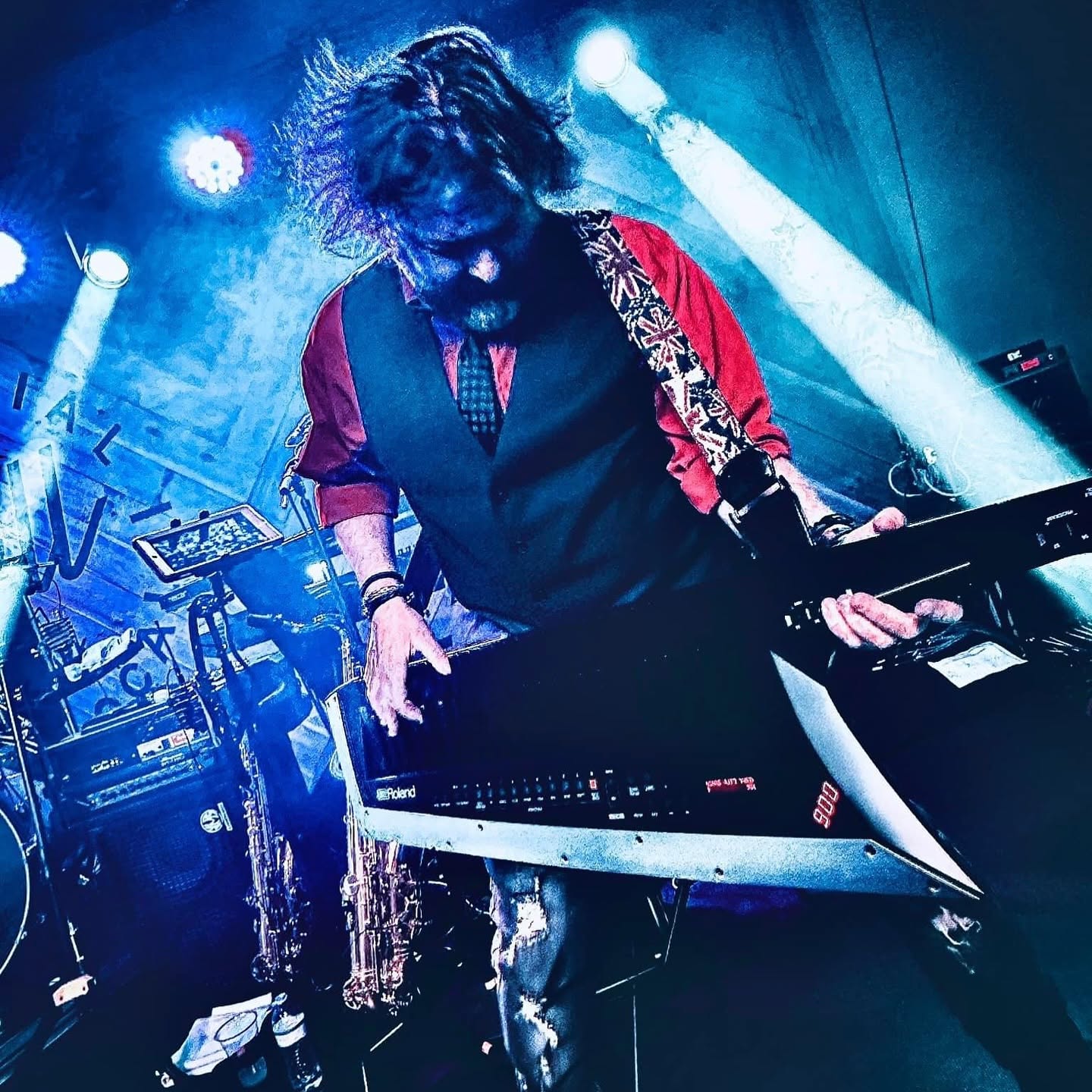
The more gigs I've performed, the more connections I've made, and between collective musician jams, playing shows, and Bandmix, I've met and been contacted by many bands and musicians inviting me to join them. When the opportunity came up to join New Sensation, an INXS tribute band, I jumped at it, realizing that it was exactly in my wheelhouse musically, and that became my primary band for a while.
New Sensation took a back seat when, in 2021, I learned that Headgames' keyboardist had left the band. Headgames is a Foreigner tribute band, and since I wasn't particularly a Foreigner fan, I had a lot of work to do to learn the material. I was familiar with most of the songs, of course, but had never played them, and actually never owned a Foreigner album. It was amazing to me how much of their music depends on keyboards, and it's been a great challenge to perfect those songs and have real input into the sound while also duplicating the records as closely as I possibly can. I've now been performing with them for six years with no end in sight. There have been some lineup changes, but with an 11-year history and numerous venues we play yearly, the band stays busy, and has built an excellent business model and organization, which I'm happy to be a part of. For several years, Headgames was my only performance outlet. Performing a couple of times a month was (and is) quite enough for me. Eventually, however, other opportunities appeared which also enticed me to pursue.
One of those opportunities in 2023 was the Transylvanian Orchestra at Six Flags Over Georgia's Fright Fest. That opportunity allowed me to not only perform at Six Flags (a lifelong dream), but also to dress in costume (something the Devo band also gave me), and also to work on the core backing track to which the band played and to which the lights and video content would sync. Ten weeks and about 80 half-hour show performances per season for both the 2023 and 2024 seasons. It meant taking that time away from Headgames both years, which I hated to do to them, but it was worth it for the experiences for myself. That connection was through a friend at church, Kermit Lowry, to whom I'll always be grateful for thinking of me when he heard about the show.
In 2025, I had an opportunity to participate in a local music showcase in which “Andrew Doss & The Werks” performed a 30-minute set of my original pop songs at MadLife in Woodstock, GA. It was the first time I've ever performed my originals publicly, and we hope to do it again sometime. It's just a question of when I can get around to scheduling the rehearsals and setting up the new date, but MadLife is waiting for me to let them know. I had the show recorded and released it as a live album, and while it's pretty raw and a little rough, it represents a real milestone for me personally and musically.
Another opportunity has been Can't Drive 55, a Van Hagar tribute, which has played some shows in 2026. Another creative opportunity in a similar vein to the Transylvanian Orchestra has come my way, so I'm currently pursuing that. Hopefully that will result in some new performing avenues in the coming year.
I've got more opportunities than I can manage at the moment, and I don't intend to ever stop if I can help it. I may be getting choosier about what I commit to, but I keep being presented with new ways to be creative and play music for people, which are some of the most fundamental keys to my earthly existence, and that will never change.
As much as I love to build things, I also love to perform and be creative. Doing those things, however, come with a set of expectations and terms that I set myself. It took me a long time to arrive at what some of those personal terms and expectations are. Despite the seeming conflicts and contradictions, I still get to do it, and that's one of the greatest blessings of my life.